Showing posts with label Rants. Show all posts

Thursday, 28 May 2026

Of Belonging, Membership and Being An Utter Tool!

The human being is a social animal. Anyone who doesn’t belong to a group tends to be viewed with caution by those who do. The demands made by the group of its members often influence the modes and the degree to which loyalty is expressed. Demands such as a membership subscription may enable the group to carry out its intended purpose and such shared payments can smooth the way in enabling the group members to take part in their shared activity. Pretty much stating the B.O.!

The human species also espouses contradictions. It’s a part of being human. Even fully paid up members of a group may consider themselves free-thinking individuals no matter how much of their individuality they have surrendered to the group. “I am a member of this gang because I think this or that" can so easily become "I am a member of this gang and so I shall think this or that". Some organisations, including religions and political parties exact a penalty for daring to deviate from the group's aims and priorities. I was raised in a high demand religious cult and coming out in much later life prompted the local ecclesiastical authority to request a meeting and accuse me of flouting the "law of chastity". I hope he felt as demeaned as I felt annoyed. I had known him since he was a child and in all that time I had never done anything more than sit in church to help my then wife with the children. I certainly had not professed any belief, since that had abandoned me long before. I did not consider myself a member of the flock, nor did I accept he had any position of authority in my life. Church had become simply a place I had to be to keep relative peace in the family. My wife and I had met and married as teenagers. Within six years I had come to the realisation that I no longer believed, but I had made what I thought was a serious commitment. I tried to support her priorities until I could no longer do so. I found myself as co-babysitter in church for more than a decade.

I joined the Ecology Party in the 1980s and was a member when they changed their name to the Green Party. I even stood for election in a borough council election in 1986. I was surprised to receive as many as 59 votes but very relieved not to be elected to the borough council. That left me free to start looking for jobs doing something I much preferred to do, namely music. When I moved out of the town to another part of the country I let my Green Party membership lapse and have never rejoined. I have felt almost tempted since Zack Polansky was elected leader and has been incredibly articulate in espousing many of the same thoughts as me on so many issues. However, I have decided that being a member of a gang is really not all that great when they start to make demands that one should think the same thoughts. I'm happy enough to add my ballooning weight to the throng in demonstrations and at rallies, if I can see the point of an action, but I'm not tempted to join or rejoin a gang. I will admit to a twinge of something approaching nostalgia every time someone calls for people to join up to increase the numbers in the party and add to the money available to fight campaigns. One of my favourite people, a kind, articulate and caring medical professional, a town councillor near where I moor much of the time, had their party membership revoked after using their professional knowledge and research to offer a different point of view to the prevailing group think on T issues in LGBTQIA+ matters. I don't know the details, but the party lost a good member who was willing to stand up for the main principles in the Green Party manifesto. As I understand the situation my friend wanted to explore nuance, but hardliners in the party would not tolerate nuance. The current leadership has said that the Party can be inclusive as long as any member is broadly in accordance with established principles. That is fair enough. Otherwise what is the point of people joining together for a common cause? My friend's expulsion went beyond this consensus. It was a witch-hunt and we've seen the same kind of expulsions happen in other political parties as well as organised religious groups. 

Does the same thing happen in the worlds of sports, the arts or other fields of human endeavour? They are certainly tribal enough. From time to time I have found myself parrotting a phrase or idea I have heard from someone else. Perhaps it seemed apt or amusing or poignant. I'm not always convinced I fully subscribed to the actual idea and it is only when someone takes the trouble to express their thoughts on something I have said that I may have been forced to confront my assertions and revisit them. Our society is all the poorer when nuance is seen as betrayal and something to be punished. A change or reconsideration of a thought may be derided as a u-turn. Whether the simplification of ideas is a deliberate ploy to mislead or an honest attempt to make an argument accessible to all, something is frequently lost in the reduction. It makes me sad when people seem not to be able to talk ideas through to find a place where different priorities might meet. "My way or the highway" leaves little room for the power that argument can offer to sway a decision. The way leaders express themselves gives permission to members of the gang to behave in good or bad ways. Why is it so often in bad ways - storming the senate, wearing masks to root out and expel people of other cultures, standing on cliff tops to gesture and shout at the sea to repel so-called "invaders" who are not invaders at all, but simply fellow humans in need a safe place to live? Were I going to "invade another country" I would probably choose a more robust method of travel than an inflatable raft. However invading a neighbouring country, manipulating the law to recruit the internal forces of law and order into dragging people away to the courts for merely sitting in a public place and holding a handwritten sign to express dissent are all crazy power games. Under threat of losing their membership, their citizenship, their jobs or their pensions the powerless will feel emboldened by the size of the gang and pride themselves on their ability to follow orders. The largest mob with the most amount of power wins and a thought-through argument does not figure in the process. I wish I saw more evidence of people who could and should know better following orders to enforce some sometimes arbitrary rules to a good purpose, but it feels somewhat rare. Maybe it's simply that the good examples happen in the background and aren't deemed worthy of attention. Only one political leader has actually discussed priorities that moved me to something other than dismay or anger. Hearing Mothin Ali discuss his passion for gardening was rather lovely. Hearing him described by those who disagree with his point of view as a dangerous terrorist is very upsetting, but I'm still not rejoining the gang.

Being the contrarian that I am, I have signed up to membership of a couple of waterways support groups that campaign and work for facilities I feel may be of benefit, but I'm still not joining the gang!

Thursday, 21 April 2022

Of A Street Poet And A Prejudiced Music Fan

 We interrupt the catch-up to bring you this rant.

It's actually something I think I may have mentioned previously, but this recent experience upset me enough that I am still mulling it over several days later.

There is at least one band I have followed for the past fifty years or more. This is one of that rare breed of bands that are still working and putting out new music. I was in the queue to see them a few days ago. Although I am older than many of the fans, this band still attracts its fair share of grey haired people ... unlike the band itself who have never been seen without hair dye or (possibly?) a hair piece. The queue had been growing for several hours and I was sitting on the steps of the venue talking to people who, quite by chance, had turned out to have come from towns near me.

I became aware of a twenty or thirty-something woman making her way along the queue, stopping to talk to people. I saw several refusing to engage with her or shaking their heads and she walked on, getting closer to where I was sitting. I suspected I was about to be asked for money, sadly not unusual in London or any other town these days. I hadn't seen any buskers or people begging in two days and I still had some money I keep for such emergencies. The woman approached and explained that she was a poet and that she was homeless. She was trying to raise £16 to pay for a hostel bed for a week. This is the modest sum I've heard mentioned several times by many people in North London in recent years and I keep meaning to check whether such cheap accommodation really exists. I have never got round to doing it though.

She reached into her bag and almost pulled out some handwritten sheets of brightly coloured paper upon which were written her poems, before quickly stuffing them back in the bag and zipping it up again. I was impressed by a fellow creative spirit who, like me, was refusing to expect people to give her money in the street for nothing. She was articulate and polite, but looked as though she could be having a hard time. I had no idea what her challenges were, although were I to judge purely by appearance I could have hazarded a guess, but I was willing to accept that the need for safe accommodation might be one of them. I happened to have money on me and handed her a ten pound note. I could see she already had some money and I knew my offering would make it up to the amount she said she needed. I'm not entirely naive and realised that it was completely possible that I was not being told the entire, or even a partial, truth. I know I've been scammed out of money on the streets before, but if someone is so needing cash they have to ask a stranger for it, I'm usually willing to share if I have something to spare. She thanked me and remembered to ask,

"Do you want a poem?"

"Of course," I replied, "that's what I'm paying for."

I couldn't tell if she was relieved or disappointed that I was taking some of her modest stock of poems. There didn't seem to be many left in her bag. She had gone to some effort to write them all by hand in a mixture of colours on A4 card and put them in protective plastic pockets. None of this was an easy or a cheap option. She could more easily and more profitably have rattled off a few printouts on a library or hostel computer, but she had chosen not to. Given the effort to which she had gone to use what talent she had to produce something she could sell I was happy with the exchange. 

When she had moved on a man closer to the head of the queue came back to squat by me to share his assessment of what he had just observed,

"I don't mean to burst your bubble, but you have just funded her drug habit ..." 

At first I thought I had misheard him, but he smirked and nodded in the supercilious way that people reserve for the ingenuous. He got up and went back to his place in the queue, which was a pity because I would have liked to explore his intervention with him. I found his comment gratuitous and insulting.

In no particular order of priority I want to make a list to work out why I felt so irritated by what he thought it was okay to share. 

  • He had no idea of what conversation had actually passed between myself and this woman and it was none of his business anyway.
  • He wasn't interested in finding out whether I had a motive for offering this street poet some money.
  • I was prepared to give her something for her work and creativity in the same way I hope people will offer me something as a tip or buy a CD when I am busking.
  • She and I had a business transaction. She offered poems for sale. I bought two.
  • I could see there was a problem. I didn't know how much was to do with a need for accommodation, but if I could offer her enough to make sure she had a bed to sleep in that was safer than being on the street or sleeping in a shop doorway it was a reasonable act of humanity.
  • Buying her poems meant I was acknowledging there was a value in the product of her creativity regardless of the quality of the work. On some level I was hoping  that my action would reinforce that this was a safer and more acceptable means of raising funds than stealing or performing some other criminal or anti-social act should they be her alternatives.
  • I remember how I felt when a woman paused from tipping me whilst I was busking last summer to ask whether I were "on drugs. I can't give you any money if you are," she had said. Either she had enjoyed the song I had sung specially for her after we'd had an interesting discussion or she didn't. To assume some morally superior stance because she had a problem with any choices I made in my life was demeaning to both of us. By that reasoning we would have to choose not to buy the work of Schubert or Shelley among many creative artists.
  • Withholding payment for work done or goods sold because I could make some kind of judgement about how she spent money honestly earned infantilises a grown adult. I don't drink alcohol or eat meat. Should I, therefore, withhold money from others because they look likely to do either of those things? How an adult spends their money is a decision that only they should need to make.
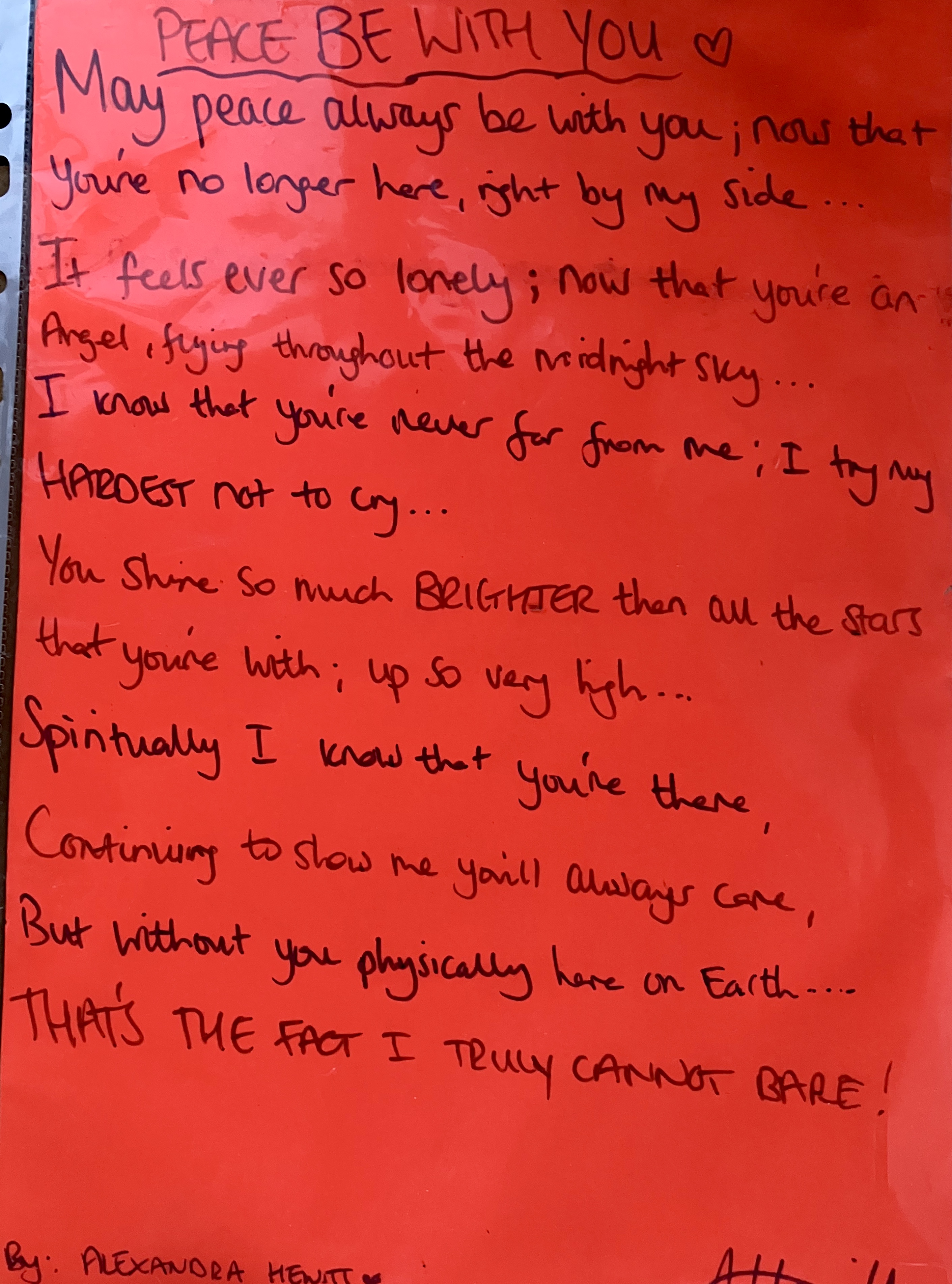
I could go on listing my arguments. The more I thought about the music fan's intervention the more incensed I became. I tried to find him again later on in the evening to challenge his attitude. Forming a judgement of my own I assumed he must have been a Daily Mail reader to have been able to have done what he did based on no information other than his own ill-informed preconceptions. I didn't find him and decided I would try and work out why I felt his intervention was so insulting rather than risk my blood pressure reaching dangerous levels. In the meantime here is a poem by Alexandra Hewitt, who has clearly experienced the loss of someone important in her life, just as I have in recent months. I wish her well. 


"Peace Be With You" by Alexandra Hewitt

Thursday, 7 October 2021

Of Thoughts On Busking

I have explained the story of why I turned to busking in my mid-sixties as a source of income this year. For a while I didn't realise that there were rules, laws and Byelaws that govern the work of the street performer. During my first couple of weeks I simply went out, set up and played. Most of those sessions went off without a hitch. I only discovered that rules existed after receiving two "yellow cards". The rules can be complicated and they vary a lot between towns. On a nearby Borough Council website there are rules that specifically mention the main town, but there are two other towns in the Borough and they don't get a mention. What the Borough Council has left out of the website information is that each town council has its own set of rules and byelaws. I've been stopped from busking in the other two towns. In one, busking is limited to market days, a Friday and a Saturday, permission must be sought and granted for each performance and a copy of one's Public Liability Insurance must be lodged with the town council. In the other, busking is prohibited in or near the Bandstand or along the seafront. The main town centre does not limit performance places, but maximum time in any one spot is limited to one hour. In another town outside this area I went to County Council, District Council and Town Council offices all within the same town and could not find anyone to give me any sensible or helpful information. I ended up setting up in a good spot in the pedestrianised town centre and talking to one of the "town centre wardens" who was actually most helpful and accommodating.

Thinking further afield some places require a prospective busker to fill in an application form in advance and agree that town's code for street performers. Some of these want a photograph and a registered name and address. Some want to see a YouTube video as part of the application process. Some require the performer to wear an official badge. Some require the performer to carry a copy of their PLI. All of this assumes that busking performances are planned sufficiently in advance of the proposed visit and take no account of health, weather or other personal challenges to going out on a specific day.  Some councils allow the sale of personal merchandise while others forbid it. Some only allow it with the purchase of a trading licence. Remembering whether performances are unlimited in time or limited to two-hours, one hour or half-an-hour and how long should be left before being able to return to a particular spot (sometimes an hour, sometimes not on the same day) can be confusing. Some towns specify and limit busking spots, some require a spot to be booked in advance while others say set up anywhere, but be prepared to move on if requested by a business owner. Some allow amplification while others don't. Most say that if amplification is being used it should not interfere with other activities. Some specify a minimum distance between different acts, some specify not to set up within earshot. Some say that once the hour or two-hours are up, a busker should be willing to surrender the spot to another waiting performer. Some claim to have devised their rules to avoid the danger of busker wars breaking out. That may be a possibility in a city housing a large and concentrated population, but I have never seen such a thing. Since setting out on this path most other buskers I have encountered have been very supportive and considerate of each other. The only problem I have encountered was with the "karaoke soprano", who probably wasn't aware of how loud she was.

Some towns make a point of selling themselves as welcoming of street performers. Some of these have a reasonable, laissez-faire attitude to performance expecting performers to manage amongst themselves according to some unwritten "Busker's Code". Many acknowledge that street performance contributes something important to the ambience of a town by adding colour and joy. Some places ban performance altogether and any attempt to flout such a rule is very heavily "policed" by private security companies. One often needs to be able to distinguish between municipal precincts or privately owned ones. The rules allowing performing in either kind of space are not always clear, although a private space is more likely to display a prohibition notice if they don't want buskers.

I suppose this chaos of rules and the insignificance with which most people regard street performances mean there is less likelihood of national law becoming the norm and setting the precedent, so it will remain incredibly confusing, specially to the newcomer. There is, thankfully, no such thing as a "busker's licence" although there are private security firms that appear to think one is needed. Most of this confusion I am learning to negotiate ... mostly requiring a quick trawl through a council website. However, there is an attitude I find difficult to deal with and that is where the rules are there simply because someone thought they were a good idea for "keeping the peace" whatever that may mean.

As noted in previous essays I have been prevented from working for eighteen months. All my work was cancelled with the first lockdown. Fortunately I live frugally and decided not to avail myself of any of the funding available to others while I had some savings that would keep me going. However, busking is not a high-reward activity. I count it a win if I earn back what it costs me to park the van, but I rarely reach the hourly 'living wage'. The best I have managed was a late in the day decision to drive to a town fifty minutes away and play for seventy-five minutes one Monday. I took £35.32 but that included giving a CD to someone who gave me a very generous tip. The parking fee was £2.00. That is very much the exception and I would say I usually expect to manage about £5.00 an hour. Among the poorest examples over the past months are:

  • one day of busking (required to move on every thirty minutes with no return to the same spot that day) - no cd sales allowed, earnings from tips £15.35, parking fees £10.00;
  • half day of busking - tips £6.33, parking £5.00
  • half day of busking - tips £0.00, parking £4.00
  • on the day of my medical emergency I played for about an hour and earned £6.02 in tips, with parking at £6.00
Some people, thankfully not a noticeable majority, equate busking with begging. Clearly I am going to disagree with this point of view. I have worked hard to develop my playing skills over several decades and a song can take me weeks or months to write, compose, learn and rehearse. I earn nothing from creating my music until I am able to perform it or sell a recording. I have yet to recover my costs of recording from sales. It could happen at some point in the future, I suppose, but it hasn't happened yet. I do not consider sharing my music, the fruits of my labour, in the street to be begging. I am offering my skills to people who choose whether or not they like it enough to offer me a tip. I understand why a local council might choose to regulate the sales of merchandise. However, buying a trading licence at many times the cost of a cd, when a single sale during a day's busking is definitely not a given, is throwing away my hard-earned cash. By selling my own CDs I am unlikely to be depriving a trader of their sales. My recordings are not available through traditional distribution networks so they never reach the shops. Of course, these days, the majority of smaller towns don't even have what we grew up calling a "record shop". The banning of CD merchandise is often simply a mean-spirited response from a local council that likes to generate rules. To put this in context, in my first twenty-five days of busking I sold four CDs. With sales like that, I am unlikely to put anyone out of business apart from myself!

I am a self employed sole-trader, who keeps good records of income and expenditure. I am scrupulous in declaring my income and pay all my taxes. I don't like dealing with forms and record keeping so I employ an accountant to deal with making sure my records are in order each year. I do, however, find I resent greatly having to go cap in hand to a local authority begging for a spot to perform, a place to carry out my work. I resent even more that they can decide on which days I am allowed to work when, for example one council only gives permission to busk on a Friday or a Saturday. How is one expected to earn during the rest of the week? I suppose there's always the dole or universal credit ... oh wait 😠

I feel another campaign coming on.

Thursday, 15 October 2020

Of Things That Crash And A Sting In The Tail

I don't have a television. I don't have a television licence so I refuse to use the watch again services of the terrestrial channels. My closest interaction with terrestrial television occurs when I pay for each Doctor Who series as it comes out and download it weekly as it becomes available. Otherwise my go to source of mindless entertainment is Netflix. Many times now I have found myself caught in the spiral of watching a series until it comes to an end. Unfortunately some are just too badly written to make it. A series I am currently watching started with a promising premise - a bunch of genius young adults with mathematical, engineering, computer and problem solving skills decide they need a "human" (their affectionate term for the rest of us) to help them negotiate their way through life. In their world EQ is not the equalisation I apply to my recordings, but "emotional quotient", something that scores far less highly than each individual's IQ. Their interpreter turns out to be an attractive young mother of a child who refuses at first to interact with the outside world. This team of exceptional people, known as "Scorpion" (giving the series its title) comes into the orbit of Homeland Security and is pimped out to solve problems and save the world - a different and often unbelievable crisis featuring unlikely solutions that are written to sound quasi-plausible per episode. As I said the premise sounds interesting, but after so many episodes and so many seasons the arc of most of the stories has become predictable. I may not make it to the end if it doesn't pick up.

I'm no genius, but ideas I have a few, though mostly these days it is my own fear and lack of knowledge that prevent me from getting on with carrying them through to completion. I have a page on Bandcamp where visitors can listen to whatever music I decide to put up and they can even buy the download version should they so wish (that would, of course be marshlander.bandcamp.com)  There is a "merchandise" option and I thought that some people might like to buy one of the limited edition and remaining copies of my CD. You know, Christmas is coming and all that. However, dealing with postage costs, returns policies, codes for esoteric functions ... I look at the page with all the boxes to fill in and my heart quails, I can feel the quailing. I have blank greetings cards of the album cover with the beautiful Mark Whittle-Bruce portrait of the not so beautiful me and the same applies. More quailing.

Another brilliant idea I've wanted to implement for some time is to make videos of some of my songs. I have lots of footage of boat trips I've undertaken, but somehow using iMovie or Final Cut Pro X escapes me altogether. I fall at the first hurdle. If I decide to start a new "project" why is anything I've imported from a previous failed project still on the screen? In my imagination "new project" suggests a blank page. If I start deleting the leftovers, what am I deleting? Do I lose the video altogether or is it simply removed from the "new project"? The video I have recorded is mostly loaded on to my computer from my phone. I attempted a Facebook live stream. I was proud of myself for managing to keep a fairly coherent commentary running during the filming while I was trying to keep the boat on course and not crash into bridges. However, somehow the audio track has been chopped into unintelligible machine gun rattles of sound. I realise that an audio commentary is of limited use in a music video, but it should make sense if I want to edit together a record of a journey I've undertaken and post it here, for example. It does nothing of the sort and the video is also pretty jerky. The "mute audio" function in iMovie took a moment to find so I clicked it, but the stuttering noise persists.  What!!?

I quite like the idea of having my music collection in one small place. After much research I bought a Brennan BB1. This has the advantage of being an internet radio as well as a music player. I can use it to listen to my friends Richard Penguin, on Future Radio and Simon J on the famous ex-pirate station 242 Radio. Unfortunately it does not seem to find West Norfolk Radio, so I can't listen to yet another friend, Jane Clayton. Regarding its other main function, it looked perfectly straightforward to copy the albums I have stored on my computer to the BB1. It is not. My BB1 seems to have given up at about 250 albums. I bought a large capacity USB key that should have had enough additional capacity for my whole collection. The BB1 does not instantly recognise the music on the key, but instead shows lots of folders that need to be scrolled through before getting to any music. The key filled up a whole lot faster than I was expecting too, so I spent more money on a solid state drive. That drive is not recognised at all. There is a computer app that is supposed to be the interface between the computer and the BB1. It is supposed to make the whole process easier. It does not.

In desperation I have referred to YouTube instructional videos, my usual source of helpful knowledge, but I've yet to find one that addresses my problems. I have registered with the Brennan users forum where the uninitiated can seek help for whatever ails them. If help is there it has passed me by because even the questions appear to be asked in some secret language. This is supposed to be a consumer product, but it is seriously "nerdy" - sorry, but I cannot think of another and less emotive adjective to describe the discussions. The questions just about make sense, but the answers are riddled with the kind of jargon that leaves me reeling. Support? It does not.

There was a time when my job was to help teachers cope with new technology in music. Maybe my brain was better joined up in those days because I thought I did a reasonable job of interpreting some tricky concepts and processes. Now, the shoe is truly on the other foot and I am lost. I think I need to engage the services of a younger enthusiast, I wonder if Ralph, the twelve year-old genius from Scorpion could help. Probably not.

Sunday, 5 January 2020

Of Post Election Disappointment Again

I'm quite used to being on the losing side. It doesn't ever stop the disappointment. After the horrible election in December 2019 I posted an article about being vigilant. It seemed apposite. The Tories have achieved little over the last forty or so years to earn my trust or my support. Many have acted with dishonour and the policies they have espoused have undermined any sense of fair play; or so it seems from where I'm standing. I look forward to being proven wrong, but evidence has yet to accumulate to ease my concerns.

After I shared the report a staunch Tory friend told me it was important to recognise that the majority had won and that I should be gracious in defeat. We were definitely going to leave the European Union and there would be no further delay. It feels as though this defines what is wrong with this particular kind of conservatism. It blames the losers for being hurt. It is surely the winner who can afford to be gracious in the winning. After all, what have they left to prove? The winner holds all the cards with an eighty-seat majority in the Commons. All I have is my ability to withhold cooperation and compliance, so don't tell me how to behave or what to feel. I'm not ready to hear that.

Surely the job of the "winner" is not to tell me how to behave. It is rather to draw me in, soothe my anxiety. Theirs is the responsibility for healing the damage. They need to prove they were right, much more than that I was wrong. I can't do their job from where I'm standing.

It seems always to have been thus. Poet/songwriter, Roy Harper, wrote the following lines in his song Kangaroo Blues:
Hey, Mr Nixon, Hey Mr. Heath
Can't you pull your pants up boys
I'm standing underneath

When my children were young they would sometimes get angry. All I knew about how to help was to hug them till they calmed down. I'm angry and I fear for worse to come. Maybe I just need a hug.

Monday, 2 December 2019

Of Byelaws and Other Nonsense

In a previous blog essay I threatened to return to the subject of the changing laws on the Middle Level. Royal Assent was awarded the Middle Level Act 2018 in November 2018. This means the Private Bill I was fighting against for about two years is now law, although I guess I should admit to being a little bit pleased that had it not been for a delivery driver, a postie, a care worker, a bar worker and this old hippy muso, boaters in the Fens would be in a much worse position than that in which they now find themselves. Our little gang with some sterling support from a retired barrister and a rather extraordinary experienced campaigner on waterways issues managed to get the Bill sponsors to accept about twenty amendments and undertakings to the original draft of the Bill that one MP in the first Commons debate described as "Draconian". The process for this to happen was somewhat curious.

Private Bills are rare. When they appear they are usually unopposed and generally favour a commercial interest of some kind - HS2 is one about which many people will have heard. Bills like these are often rubber-stamping exercises. Had we not made our arguments against the Bill over eight days of Committee in Parliament I don't think any of the amendments would have come about. Despite the fact that we proposed most of them (although I personally wanted this example of feudalism to be thrown out altogether) it seems to be one of the many Parliamentary procedures that confuses me so much that it was deemed more fitting for the Bill's sponsors to propose the amendments that scuppered the worst excesses of their own ambitions. For what I believe is the first time, laws relating to the inland waterways in this country have secured some recognition for live-aboard boaters, including continual cruisers, to be recognised as a special group. It was written into the 2018 Act.

I have been surprised, therefore, that the "consultation" document proposing draft Byelaws, as allowed for in the 2018 Act, seems to have returned to the spirit of the original "Draconian" Bill. I still object to people having the right to come on to my boat, my home, to check that I am complying with their rules. These people do not own my boat, I do. These people do not own the waterways, they are there to keep the land free from flood and keep the waterway navigable. The law now gives them the power to impose a licence arrangement. Alongside that they already have the power to require that I have the correct insurance. My insurance company requires that I can prove I have a valid Boat Safety Scheme Certificate. No local authority has the right to enter people's homes merely on the flash of an identity card or even of the twenty-four hours notice this navigation authority thinks is sufficient. Even the emergency services require a very good reason to come into someone's home uninvited and the police would require a warrant. I am mildly put out, verging on outraged and I'm a white (and by implication, privileged) man. I can only imagine how impositions such as these would be seen by solo women boaters, for example.

The 2018 Act requires that the new Byelaws be drawn up in consultation with a Navigation Advisory Committee. Before the Act there was no such thing as this Committee. Somewhat naively I expected there to be a little bit of a democratic process to define who is going to be called to serve, specially when they are meant to be looking after my interests. A search on the navigation authority's website is a frustrating affair at the best of times. It has all the appearance of a professionally constructed site, but whoever designed it should really have a think about what a website is for. Finding any information, even using the built-in search engine is difficult. I don't understand how it is also so hit-and-miss. These are computers. If I use specific search terms one day those same terms should find the same results the next. Unfortunately, that rarely seems to be my experience. After a hint from another boater I found a set of minutes that listed names of people from organisations who had apparently been invited earlier on this year to sit on the Navigation Advisory Committee. There are no minutes of any Navigation Advisory Committee meetings which the 2018 Act made a legal requirement to consult, either to agree or to go to binding independent arbitration on a number of matters including the drawing up of the Byelaws. Instead, the list of Committee members I have seen recorded in the minutes of a different meeting altogether shows no hint of democratic process. This authoritarian organisation has made a list of its friends who accepted without question the first version of the Bill, you know - the Draconian one, and asked them to join the gang. There is no one on the list I have seen who has actually questioned the navigation authority about their decisions and behaviour so far. The liveaboard "representatives" actually spoke for the sponsors of the Bill, as expert witnesses, during its passage through Parliament. Perhaps I was being overly sensitive, but many people living on their boats just about get by. We don't have the means to be able to buy new boats from the spoils of a superannuated job and the sale of an empty bricks-and-mortar nest. There are some who seem to think the inland waterways are best left as a reservation for those who can keep their boats looking pretty and thoroughly maintained. This was certainly the message I took from this particular "expert witness" in Parliamentary committee. As far as I can tell there are no solo boaters on the NAC either.

I have long suspected that democracy was not what most of us assume it to be. What I experienced during the Parliamentary process and my eight days in Committee was an appearance of being part of the democratic process which, on reflection, may not have been real. My first shock was the chairman of the Committee of MPs who went back to Parliament and gave a speech on behalf of the Bill's sponsors. He was clearly not as impartial as we thought. I have more respect for the process as it went to the Lords where the sponsors were given a good grilling over many of the points we, the petitioners, had raised as well as a number of others we hadn't. The Lords seemed to have read (and, more importantly, understood) the documents. However, the end result was that the sponsors got what they wanted. Of course they made concessions in terms of their undertakings and amendments, but we were not seriously party to those decisions.

Now we have the draft Byelaws and consultation for these has closed. I did not even know about the draft Byelaws document until a fortnight before the consultation period ended - strong sense of déja vu here. In Parliament one of the sponsors made it clear that important notices could be delivered directly to boats. The draft Byelaws that are going to have such an impact on my life for as long as I am in this area were clearly not considered sufficiently important to justify notifying me. I don't suppose many others heard the news either. In fact I know they didn't. The farmer who owns the land near where I moor regularly didn't know until I told him. The member of the navigation authority who lives next door may have known, but he doesn't speak to me, not even to return a greeting.

There are going to be some aggrieved people come the time the Byelaws are rubber-stamped into existence. One of the new rules states that boats cannot be moored within either ten metres of a bridge or thirty metres of any other water control structure. Going through the nearby villages on my trip last weekend I made a mental note of boaters with garden moorings. Some of them are adjacent to bridges. I knocked on the door of someone in such a situation and asked whether he knew about the Act and the draft Byelaws. He said he had heard of them, but had no idea what was in them. "I expect a letter will drop on to my mat before too much longer," he said. I was very disappointed that a) many people are so fatalistic about these unnecessary impositions and b) he wasn't prepared to do any legwork to find out for himself. "Do you realise your boat will be moored illegally once the Byelaws come into effect?" I asked him. "You are right next to a bridge." His garden isn't wide enough to move the boat ten metres away from the bridge. "It's a footbridge," he replied ... "and just let them try!" He has more optimism that he can fight the system than I have. I'd hate to see him lose his boat, because he thought it couldn't happen to him.

The proposed Byelaws are full of absurd ideas. One of the original petitioners found fault with many of them and listed eight or nine ways the proposals are actually in contempt of Parliament. I wrote an eight-page response to the proposals. I'll finish this essay by giving just one example of the poorly-considered changes to our conditions of being here. In fact, what the proposed law contains is not just daft, it puts single-handed boaters like me in danger if we attempt to comply. I hope the  arguments I have given in my response will cause the section on using locks to be amended.

Locks are dangerous places. People die in them. I take the greatest of care when using a lock. The proposed Byelaws state that a boat should be secured at the bow and the stern when going through one. I polled a discussion group of single-handed boaters and all who responded, just like me, only ever use a centre rope to steady the boat in a lock. Trying to keep on top of everything while water is rushing in or out requires great care. A boater on their own cannot safely control a 50' steel boat like mine (or a longer one like many) using both fore and aft ropes. That is possible only with a crew. Even if I could reach both ropes at the same time I could probably not hold the boat steady with the different forces acting on it in the lock. I don't like to tie the boat to the bollards because I may not be able to release my rope quickly enough when I need to do so. Tying up from both ends is unthinkable. The last thing I want is to hang my boat and submerge it if I couldn't get to one of the ropes quickly enough! The law is in great danger of becoming the proverbial donkey. I certainly do not want to serve on the Navigation Advisory Committee (and couldn't anyway with the kind of peripatetic life I have), but I don't have any confidence that the navigation authority knows how to approach people who know what they are talking about. If you hear about boaters dying in a lock in the Fens, or losing a limb, you'll know the navigation authority probably didn't agree that I have a point.

This man is someone whose blog I have followed for a few years. He knows what he is talking about too.

https://livingonanarrowboat.co.uk/why-a-narrowboat-centre-line-is-so-important-for-solo-owners/

Thursday, 8 February 2018

Of Men In Distress

I don't know how it works that £16 can buy a permanent place to stay, but that’s what he said. How could I argue? The poor man was clearly very distressed. It was not even six in the morning and already the homeless were out and about. Being homeless, perhaps he’d been out and about all night and it hadn’t been the kind of night I would have wanted to be outside; not at all.

I came down to London yesterday. I arrived about 8.30pm and stayed overnight with my dear friend from my schooldays. As usual, M and I discussed our latest political adventures, art and music. We shared our news to the gentle accompaniment of his newly discovered ukulele chords while I noodled on the guitar I had restrung for him a couple of weeks ago. We mardled till gone eleven and he called time first. He had to be up at five for work. I had to be up at four to get a train to Paris.  

There seems to be a hierarchy of platform information on the Bedford to Brighton line. During the night plans can change in an instant. This was a phenomenon I first encountered when, for a while, I used Leagrave Station regularly. The same phenomenon seems to affect West Hampstead too. It was while I was mulling over the implications of how a train that had been due on Platform One in four minutes had become a train going to another destination in fourteen minutes that my train arrived ... two platforms away. Maybe it serves me right for staring at the half-occluded moon through the screen of tiny, gently falling snowflakes. There was no way of knowing that the new arrival was actually the train I wanted, but there were clues. It was heading in the right direction, there were only two stops to St Pancras International and check-in time was approaching. I ran with my large suitcase and heavy backpack up the stairs to the footbridge, along the footbridge and down on to the new “right” platform. I don’t know why or how this happens. It’s not as though West Hampstead is in the middle of nowhere. I hurdled the gap to mount the train, but the necessary exertion felt rather extreme and, as I sat in the train with the doors closing, gasping to catch my breath  and hoping my heart would hold out for the remainder of the day, I realised once again that I am not a fit man; certainly not in the traditional sense and barely in my own imagination in any other sense.  


I know I’ve mentioned this before, but checking in for international trains is so much more civilised than checking in at an airport. Having ignored those signs that now forbid taking suitcases on the escalators, I was making my way to the Eurostar entrance at St Pancras (with as much optimism as I could muster after a night’s sleep lasting one hour and forty minutes and a fierce attack of insomnia) when I passed a lonely piano. No one was there to tease music from its keys and strings, but I was vaguely aware of a couple just ahead of me - at least without looking directly at them they looked like a couple - until one half, the male half, shuffled my way. I am very familiar with that shuffle. He was coming to ask me for money. Being about to go through security I had taken all my change out of my pockets and put it into the pouch strapped to my waist. Since it was still only 05.45 I hadn’t anticipated meeting any homeless person who needed money and hadn’t got my “buskers pocket” ready with the £10 I usually budget for a day in town. His opening gambit was to hold open his hand and display a modest collection of silver and copper coins. I couldn’t make out everything he said, but he was clearly very distressed. It seemed he had been trying to raise enough money for some sheltered accommodation. In three days all he had managed to beg were these few coins. He seemed convinced that £16 would secure him somewhere to stay tonight and on nights to follow and I think he was facing a deadline, or at least he seemed to feel he was. He said people had been very unkind. He looked as though he’d had a rough time. He had indeed been through the wars. He told me he had been in the army, bomb squad, and had also been shot. He’d fought for his country, it had affected his nerves and he hadn’t expected to be treated with the contempt he’d encountered on his return. He kept pulling at his sleeves which revealed informal tattoos and patches of what looked like red dye. “I’m not an addict,” he declared, “but here’s where I was injured”. I lost his thread at that point as he explained that he was so upset that so few people seemed willing to help.  My judgmental side was about to explain that no one should feel obliged or coerced into giving him anything, but looking at the pathetic handful of coins, I broke my usual rule and pulled out my wallet. I fumbled around for a five-pound note and offered it to him. “That’s really kind of you,” he said, “but what good is that going to do me? If I don’t get the sixteen pounds soon I shall lose my bed. I can’t spend another night out in this weather. I can’t stand living in this world where people are so unkind. I’m going to finish it.” He made a slicing motion across his throat with his fingers. I would love to have had enough time to sit him down with a cup of tea and encourage him to share his story, but I needed to get my train. I put the fiver back in my wallet and on impulse pulled out a twenty and pressed it against his hand. “Sixteen pounds is what you need today?” He had been on the verge of weeping when trying to articulate his situation, but now the tears flowed. He grabbed my hand and thanked me over and over. It was reward and embarrassment enough to be able to conjure in my conscience a little hope that this small gesture would help take some of his immediate worries away. I’ve known depression and I’ve known suicidal despair, but I could not begin to imagine what this man had been going through, nor did I really know why he needed that precise amount of money. I know I’ve been lied to by people begging in the streets before, but that isn’t the point and nor does it worry me as much as the fact that they were forced there in the first place by circumstances likely to have been beyond their control. Were I in that position I think I would learn to do and say whatever I could to get through a day if I hadn’t died first. The handshakes clearly weren’t enough. He threw his arms round me and locked me in an embrace. My first thought was alarm. I didn’t want to have to deal with head-lice if he had them. I have enough difficulty communicating in French without having to take a trip to the pharmacie. This thought was quickly quashed by shame. When was the last time this man had been hugged? I pulled him in closer and held him until he was ready to pull away. Still thanking me he started backing away and wishing me a safe and happy journey. I hope he has an hour or two of relief from his  burdens. London’s mayor is currently running a campaign in support of relief for rough-sleepers. No one should have to sleep rough. This man has obviously fallen through the net and he cannot be the only one. Two of the last three or four rough sleepers I have met and spoken to are talking about suicide. One of them may even be dead; he had a plan. Just one is too many. Such talk is unlikely to be a coincidence. Homelessness is becoming an increasing problem and is affecting more and more of us. It is an indelible mark on our collective conscience and, unless this nation looks closer to see what is really happening out there, it is going to become much worse. I hope I don’t meet you on the streets.

Sunday, 17 December 2017

Of Anger, Guilt And Powerlessness

I woke up this morning. A man I met yesterday was determined not to. I feel angry, guilty, frustrated and really, really sad. For family reasons I had spent a few hours near a town in what looks to be a very prosperous part of the south of England. Before getting stuck into the 150-mile drive back to the boat yesterday I diverted into the town centre to buy some guitar strings. I’ve only visited that town once before, but as town centres go, it is quite attractive. It is on the River Kennet and there are narrowboats. The afternoon light was fading and I didn’t have time to take a riverside walk. I was trying to get back in time for the first performance of a community singing group started by the Drama Lady.

I bought my strings (and some other bits I hadn’t intended) in Hogan Music, a very friendly independent and interestingly stocked music shop and wandered further into town. That’s where I saw him. Sitting on the ground in the near zero temperature in an alley just off the High Street. I tried to remember where he was and decided I would talk to him on my way back from buying a birthday card. I don’t go into towns very often - not when most of the shops are open anyway - so I have to remember things like birthday cards when I get a chance. A few minutes later when I returned he had relocated a few yards into the High Street. I didn’t blame him. The alley was probably a wind tunnel. He was sitting in the doorway of a closed, darkened shop. His knees were drawn up and draped with a thin woollen blanket. Although his coat looked warm, it probably wasn’t.  He looked utterly defeated. Even his hat for voluntary contributions looked wretched. Someone had dropped in a piece of costume jewellery, a brooch of some sort, but I could see no money aside from a few coppers.

I asked if it was okay to sit with him and he looked at me from a very long distance inside himself. I sat among some empty sandwich packets and coffee cups. I have assumed until recently (because several street people have told me so when I’ve done it) that it is unusal and welcome for a stranger to offer a few minutes of time when they drop some money into the hat. In my middle-class, do-gooder way I breeze in and out of their lives for a few minutes of my precious time and feel suitably virtuous. When I visit a place I make sure I have ten pounds in my pocket, which I know I may end up sharing among street people, people busking, people begging and sometimes even people selling the Big Issue. If I didn’t set myself a budget I might be tempted to give everything away. I’ve done it before and given away my train or bus fare. Sometimes I buy myself something from a sandwich shop and get something extra for someone I have seen. I never know whether food and a warm drink is welcome or whether the bodies of these people need some other form of nourishment. I know mine would be screaming for fruit or fresh vegetables (and probably, I confess, some very, very dark chocolate) if I tried to live on a diet of burgers and pre-packed sandwiches.

Sitting with people for a while they invariably have a story to tell. Often just one event has happened to turn their lives completely upside down. There are times in my own life when that could have been me. In Highbury, a few weeks ago I tried to spend a bit of time with people who clearly didn’t want my company. I hadn't really encountered that response before. One man outside the tube station had a palsy so bad he was risking spilling the change right out of the plastic disposable cup in which he was collecting contributions. I couldn’t tell if his attempts at speech were the result of his condition or whether he spoke little English. Whatever, with such violent tics forcing his body to run flat out he must have been exhausted. A few minutes later I dropped some money into the bowl of a very young man who had just enough English to point down the street and tell me to go. “You give money. You go!” He exclaimed in a voice that sounded fearful. Just what had happened to detach him from social contact with people in such a desperate fashion? His response made me question my actions. I thought I was trying to treat each person I spoke to with the same kind of respect I would want for myself. I always ask if it's okay to chat. I know they must be wondering what it is I want from them. I think most of us need something and that what they need is likely very different from what I judge to be the case. What have I been expecting or wanting? I didn't think I wanted anything from them. I felt that there was little enough I could do to show a little bit of human kindness - I have enough for myself with enough to share a little - but maybe I need something more than that. What? Absolution? If I'm lucky I may get a song out of it. Then I have to balance the right to exploit someone else's misfortune against an opportunity I perhaps have to raise awareness. Has Ralph McTell saved any lives by writing and singing "The Streets of London"? My approach to street people since then, however, was to be very unsure of how best to approach them or, indeed, whether attempting conversation was a good idea at all. On balance I think it may be. Too many street people have said how they appreciated someone spending a few minutes with them, having someone look at them rather than the other way and having a chance to tell their story.

There is always a story. Here’s one from a man I also met yesterday. Thirty-three year old P had lost his job, his girlfriend and his flat. He had a place in a shelter which accommodated him and his companion of many years, his dog Tizer. Tizer had a temperature. P took him to a vet who prescribed antibiotics. A few days later Tizer regurgitated blood, lots of blood, seven towels worth of blood. Tizer turned out to have cancer and P couldn’t afford the prescribed operation after he’d already paid out for treatment. He had to say goodbye to Tizer. Then the hostel presented him with a bill for six months of arrears. He had been keeping up with the £17.50 a week that had been asked of him, but now they were telling him that his benefit payments didn’t cover the remainder of a bill he did not realise he was incurring. He had to leave and I was speaking to him as he prepared for another cold night in the open while still mourning the loss of his mother and the more recent loss of his dog. He asked me my name and tried to guess my occupation. He thought I was an artist ... or a hippy! He was pleased and not surprised to find out I was a musician. “What’s your instrument?” he asked. I told him to guess. He said I couldn’t be a drummer or a trumpet player. He thought I was a violinist or a flautist and seemed disappointed when I told him I was a one-man band and did play percussion. We shook hands as I got up to go and he laughed when I told him that his name was the same as my boyfriend’s.

Back in the High Street the defeated man showed signs of being seriously strung out. He spoke slowly, quietly and with effort. There were many pauses in his tale while his eyes went into periods of hibernation before his voice petered out. Then he would re-emerge for few more seconds to move the story on. He had spent the previous night indoors at the invitation of a “friend”. Come morning his sleeping bag, blanket, some spare clothes and his friend were all gone. I was horrified and outraged. He told me to take back the money I had dropped into his hat. There was no point and he no longer wanted to live in a world where such things could happen. I told him to keep the money in case he wanted a cup of tea and I bade him farewell. I knew I couldn’t leave it there. I found a charity shop which, fortunately, was still open and went inside to ask if they had any sleeping bags or blankets. I related the story. The volunteer looked at a few unsuitable options and said she would see if there was anything more useful in the back of the shop. She came back with a bagged up king-sized duck down duvet. I realised this was incredibly bulky for a homeless person, but the evening was getting colder, so I bought it and took it back to the defeated man. I asked him if he minded if I left it with him, because it was wrong that someone should take his stuff. He barely acknowledged me as I placed it on the ground beside him on top of more food containers I hadn’t noticed before.

“You won’t see me again,” he said. I said he was probably right and that I wouldn’t be back to that town for a long time. “No, I just don’t want to live in this horrible world where friends steal each others’ things. I’m going to end it tonight. I shall stay here and get as much money as I can to buy as much heroin as I can get and then I’ll o.d. I have no reason to live and I will die tonight.” He was very matter-of-fact. He had reasoned this out. However shocked I was at what he was saying I could see his reasoning. What would I want were I in his shoes? I had to admit it could easily be something very similar. “I said, okay that has to be your choice, but I hope you can remember that the world where friends nick your stuff is the same one where someone you’ve never met before and will never see again gives you something to try and keep you warm. I hope something good happens for you.” Immediately I hated myself for being so supercilious, but it was the best I could come up with on the spur of that moment.

I left, shaking and weeping. A big voice inside me was telling me to alert someone to his plans, but who should I tell and what would be the result of me saying something? The best that could happen would be that some official would turn up and his freedom would be taken away. I needed to talk this through and the only place I could think of was to go back to the charity shop where the volunteers had been so kind and helpful. They gave me a chair to sit on and a few minutes of their time as I composed myself. When everything else has been stolen from us is it right to take away that final microscopic thread of dignity to make a man conform to our own view of how a life should play out? I’m guessing and hoping that the defeated man had nothing like the amount of cash he needed to be able to close his body down in his chosen manner. I’m also hoping that he wrapped himself in duck down and began to feel differently as his body became a little less frozen.

I turned the wrong way and couldn’t find where I’d parked my van. Asking directions I had to walk the length of the High Street again, passing his spot once more. I saw the defeated man and he was on the move. He was up on his feet and stooping to collect his remaining belongings together. I really wanted to see if he took the duvet with him when he headed off, but that would have ruined the point of the gift. Sharing this experience with you probably also defeats the object. This is not a tale about me, but I am trying to work out what I experienced. It is an expression of the shame and anger I feel that some of us are forced into such a place that suicide appears to be the only remaining option for self-determination. So, in the face of homelessness - and climate change, species decline, greed, famine, war, sickness and poverty - we’ll keep intoning the mantra, “Brexit ... Brexit ... Brexit” and congratulate ourselves on getting our country back; we seem to be doing a jolly good job there.

Yes, I woke up this morning. I was in my comfortable bed and although the cabin on the boat was cold at only 12ºC, I wasn't affected by the wind and, while raining, the rain was falling outside and not on me. Neither had I been kicked awake by some drunken louts out for a bit of "fun". I hope the defeated man woke up today. I hope he experiences a little bit of kindness. I didn't make it back in time for Drama Lady's concert. I hope I didn't make the defeated man's life worse.

Monday, 6 February 2017

Of Level Middles, Rights Of Passage and Bills Of Fair (Part 2)

The Nene-Ouse Navigation Link is part of what is primarily a drainage system known these days as the Middle Level. The Middle Level drainage and navigation functions are administered by a body known as The Middle Level Commissioners. When I lived in a house I received annually a bill from the Commissioners for the services I received in terms of drainage. I think this may have been on account of having a narrow dyke (known everywhere else as a ditch) marking the boundary at the bottom of my back garden. The dyke was overgrown and rarely tended by anyone during the fifteen years I lived there, but the bills kept coming ... at least I assume they kept coming because after a while they were absorbed into council tax bills and it all happened rather less visibly.

I don't have to spend long thinking about the number of houses in Norfolk and Cambridgeshire, to realise that drainage money for not actually doing very much probably brings in a tidy annual amount. On top of this farmers and other landowners pay per acre for drainage and they pay again if they want to take the water that has already drained off their land and into the waterways to use it for irrigation. Commissioning must be nice work if you can get it.

The Middle Level Commissioners used to have offices in March (a town in the Fens, not the month ... they do actually have the offices all year round) and they still do, but a few years ago they sold off the old offices by a busy set of traffic lights in the town centre (the building is now The Hippodrome Hotel owned by Wetherspoon's), and borrowed a large sum of money to design and erect a new building next to the river. It is a very nice building as modern buildings go. There are, allegedly, some eighty-plus to ninety-odd miles of navigable waterway on the Middle Level according to the guidebooks, or a hundred according to the MLC website, and it is acknowledged pretty widely that one has to be a certain kind of person to enjoy using them. I count myself in that special breed although a high boredom threshold is a necessity since travelling along most of the wider drains, such as the Sixteen Foot, The Forty Foot and probably even the Twenty Foot (although I haven't yet tried that one out in the boat) is akin to riding those boring bits of train journeys that pass through cuttings with high embankments on either side permitting neither a view of the adjacent countryside nor any kind of mobile phone connection. The reason for this being, of course, that the Fens have lost so much top soil in the centuries since they were drained and used for growing crops that many fields now lie below sea level, below any roads that pass beside them and below the rivers and drains that keep the arable land in a fit condition for arable farming. Water needs to be pumped up into the drains to prevent flooding in some places. Without the drainage work that has been carried out since the middle ages, but most dramatically during the seventeenth century at the behest of successive Dukes of Bedford and under the direction the Dutch engineer Cornelius Vermuyden, the Fens would not have developed into one of the most important and fertile agricultural areas in England.

People tend to be wary of change; history has often shown they have good reason.  Those who for centuries had learned how to live in the Fens, through wild-fowling, fishing, eeling or collecting reed for thatching found their livelihoods greatly diminished as the newly-reclaimed land was being sold off or given in favour to interested parties and vested interests such as the fourteen Adventurers who underwrote the reclamation. These adventurers awarded themselves 43,000 acres, gave 12,000 acres to Charlie Wag (King Charles I) and rented or leased off another 40,000 acres that was expected to cover the costs of the upkeep of the drains. The Fourth Earl of Bedford, Francis Russell, acknowledged that there was an imperative for recompensing people for removing their freedom of movement and their livelihoods. The continued sabotage of drainage works by Fen Tigers must have helped focus his mind; it is unlikely he acted wholly altruistically. He set in place, through an Act of Parliament, the rights of the people to enjoy free passage in perpetuity. This applied to a class of traveller known as the "pleasure boater". Boats engaged in commerce or trade would be required to pay for a license with the exception of those carrying specified goods and raw materials, including pigeon dung! Reading though these details recently has reminded me of the opening spoken section of the Lonnie Donegan song, "The Rock Island Line", one of my favourite songs as a child (and one of John Lennon's too if the stories of him playing the record so many times he wore it out, getting through several copies, are true). In The Rock Island Line the engineer (train driver) has to declare what goods he is carrying. He claims, "I got all livestock, I got all livestock, I got all livestock," but as he passes the toll point and picks up speed he calls back, "I fooled you. I fooled you. I got pig iron!" pig iron being subject to a toll whereas the livestock weren't. I wonder how many commercial vessels on the Fens carried cargo that went undeclared?

The Middle Level Commissioners were set up as an independent body by another Act of Parliament in the nineteenth century. This had the effect of separating them from the Bedford Level Corporation that had been established two centuries previously . The rights of people to use their boats through the navigable part of the drains has remained. It was ever so from Roman times, enshrined in Magna Carta and confirmed in all subsequent Acts from the drainage programmes of the seventeenth century onwards.


This, however, hasn't stopped the Middle Level Commissioners trying to change things. They have long seen boaters as an untapped source of income. There are about two thousand miles of navigable  inland waterways in the UK. The Middle Level Commissioners claim to be the fourth largest authority looking after (let's be generous) one hundred of those miles - i.e about 5%. They are also the only navigational authority in the country to receive money from the Environment Agency for flood defence. There are seven locks associated with the system, two of which (Horseway Lock and Welches Dam Lock) have not worked for years and are, therefore the effective end of navigation on the Forty Foot River.  Bevill's Leam is also useless as a navigation because there is a pumping station near one end that prevents it being an aquatic thoroughfare and Old Popham's Eau is similarly sealed off at Nordelph, only this time by a weir - and so it goes on. Most of the operational locks are also required for sluicing, i.e moving water from one place to another to prevent flooding. Some of the Middle Level sluices also keep tidal water out and there are huge pumps to move excess water, including Europe's largest at Wiggenhall St German, near King's Lynn - however, I am not sure if this one comes under the direct authority of the MLC. While I am not moored on a tidal stretch, the depth of water around and under me can vary greatly and change very quickly and is affected by what happens at St German's. Two nights ago the level went down very considerably overnight. I keep my mooring ropes loose because this is not uncommon. There is no mechanism for warning boaters of sudden and severe changes. Last summer I took my boat to a festival. Twenty-four hours later I got stuck under a bridge through which I had passed unhindered the previous day and only got out with some damage to the boat. The story was that someone had inadvertently left a gate open at one of the pumping stations. About a year ago I wrote in this blog about the devastating effect that unnotified changes in water level can have on the property of boaters when six boats that I knew of ended up being sunk after being caught up in sudden fluctuations of water level. One of those was a cruiser moored nearby. I had to notify the owner and, when he could finally get back to his mooring from working away, I helped him refloat his boat. These fluctuations are clearly functions of the vital drainage operations for which the Commissioners are responsible and from these actions it is clear that drainage and flood defence are indeed the priorities.

Regarding facilities specifically for boaters, there aren't any. The Middle Level Commissioners have no towpaths to maintain; they provide no facilities for boaters - no moorings, no refuse collection, no sanitation or pumping out facilities or indeed any water points for taking on fresh water. They certainly don't provide any laundry, shower or refuelling facilities. There are three privately owned marinas, two near March and one near Ramsey. I only know about one of the facilities at March, which I have used on a few occasions and where I have refuelled and used the water, sanitation, shower and water points whilst having work done on my boat in their yard. Any facilities, mainly 36-hour moorings - few and far between as they are - are maintained by the relevant town or parish council, a local trust or a pub.

The Middle Level Commissioners have tried a few times over the years to get the law changed so they can begin to charge boaters. At the moment there are no means of registering one's boat and no requirement to buy a licence. Any change in this arrangement requires a new act of Parliament. People who own property adjacent to one of the rivers have traditionally been able to use their river frontage as they see fit. They have, after all paid a premium to own the property. If they have a property where the waterway frontage is one of the drains the situation is different and they do not have those same rights or ownership.

Two weeks ago the MLC sponsored a Private Bill through its first reading in the Commons. This Bill is their latest attempt to get the law changed so that they can start milking boaters for money in return for ... well, nothing actually. There is nothing in the proposed Middle Level Bill, which offers boaters the facilities available on other waterways. They claim they may undertake to provide some services, but there are no binding commitments on them to do anything. They seek to force upon boaters many obligations though, through obtaining powers to introduce new bylaws. I could maybe accept something for something (albeit grudgingly), but that is not on offer. Instead, the MLC are wanting the power to make me pay them to register my vessel, charge me an annual license fee, pretend they are a "local authority" without any of the obligations a local authority has to observe, accept new powers for them to enter my boat, to confiscate it, to sell it along with my personal belongings, and propose a number of ways that I can be turned into a criminal which do not exist in statute for either house owners or road vehicle users. I find this is not acceptable and I fail to see the fairness in their proposals. The proposed bylaws also seek to firm up the power that the Commissioners claim to have to tell people how they can use their gardens or fields if they are close to a waterway.

The MLC claim to have notified all interested parties of their intentions in a consultation which, quite by coincidence I am sure, ended a week after last year's EU referendum. I am pretty sure most of us were preoccupied with other matters at the time. The first I got to hear that the long-rumoured Bill was actually ready to roll and had a date for its first reading in the Commons was just before Christmas, about two weeks before it was due to happen. Of all the "interested parties" that had responded to their consultation last year only one boater's club was represented and three angling clubs; other respondents included some genuine local authorities. No unaffiliated boaters were represented and certainly no one who lives full-time on their boats was consulted; strangely, neither were farmers who pay to drain and irrigate their fields nor the property-owners who pay annual drainage rates to the Commissioners.


It may just be that I live with my head in the sand, but I don't think so. The Commissioners seem not to have given much thought to the very serious consequences their proposed changes will impose on people and the security of their homes. Perhaps I am being unfair; maybe they did give lots of thought to us, but in the end they don't really care?

I have seen the work they do at close enough hand to know that if they get more power they will want to use it. From my boat there is only one tree visible. It is a home or a shelter to many birds, including my beautiful kingfisher neighbours, and who knows how many other species too. More than once Middle Level workers have come to cut it down because it interferes with the park-like quality they wish to impose on their "easy-care" river banks. If I kept the river bank next to me in the state the Commissioners would like to see I would be very surprised if the grass-snakes, lizards, buntings, warblers and the variety of small mammals (all of which I have seen in the past twelve months) would stick around. I was under the impression that plant life held river banks together. We know that here near the farm their scorched earth gardening style has caused the bank to subside and slip into the river. That caused the bank to start leaking, a serious threat to the credibility of their flood defence responsibilities.

More controversially, when I first arrived I used to see a particular boat pass by quite often. I never met the owner of the boat, but I did exchange a few e-mail messages with him after a very sad incident when his boat was broken into and his engine stolen while he was on a mission taking one of his dogs to a specialist vet many miles away for treatment. Without this treatment the dog would have been put down. After stealing his engine the thieves set fire to the boat, presumably  to destroy any evidence. Everything the man owned was lost in the fire and he was too far away, in Yorkshire, to do anything about it immediately. Obviously there are more details and at least two sides to the story, but the Commissioners salvaged his boat and confiscated it until he could come up with nearly £6,000 to cover their "costs". The man had pleaded for time to recover the boat himself, which was not granted. When the boat owner could not come up with the salvage money the boat was advertised and eventually sold on eBay for £3,000. The Commissioners continued to demand the balance of their "costs". The man did not only lose all his belongings in the theft and fire, but what was left of his home was taken from him and sold at a price that left him with less than nothing. He had been prepared to recover the boat and he was prepared to re-fit it so that he could have his home of fifteen years back. There was a campaign on one of the funding-type websites which raised nearly enough to cover what the Commissioners eventually accepted on eBay, but to no avail! What a tragic state of affairs.

I would hope that no "local authority" would have it in their power to evict a home-owner and sell off the paid-for home of anyone living in their area with absolute impunity. A local authority would also have to take some measure responsibility for anybody that they themselves had made homeless. The Middle Level Commissioners, through this Bill are seeking the power to take people's homes, but seem to be very quiet about responsibilities that must come with new powers.

Those of us living on and using the Middle Level waterways are watching the outcome of the petitions that have been lodged against the Bill. While HS2, a similar style of Bill, may have attracted hundreds of responses in opposition, the relevant office at Westminster consider the Middle Level Bill campaign unusual in that this relatively unimportant Bill has attracted as many as six petitions against. Most Private Bills go through unopposed. The office has mentioned that representations in person are made against Private Bills maybe only once or twice a year. The six petitioners against this Bill presented themselves at Westminster on two consecutive days. This alone is an indication of the strength of feeling. The campaign is continuing.

Saturday, 8 October 2016

Of Clockwise Days

You know the kind of thing. You get up perfectly early enough to do what you have to do before you leave your home for a few days. You've made the journey a dozen or more times a year for a dozen years or more and there is minimal packing - just computer, tablet, phone, a coat, some papers for work, notebooks of half-started song lyrics, a manuscript book for emergency tune writing, new flute, so you can try and get a better sound following a first lesson, clean underwear and the stuff you have been commissioned to purchase by your Anglophile partner who is unable to buy decent tea in France, or Bittermints, or Cheese Cheddars. He still has jars of Marmite from a previous visit.  Then as you prepare to leave, you do that final check - windows are closed, power is switched off and no gas is flowing, lock the back door and the front door. You can't do the front door till you leave the boat, but the back door now has a different locking arrangement owing to modifications carried out at the time of August's great repaint. The modifications have, however, greatly compromised the very simple, but effect security you had in place. Until now unwanted forced entry to the boat would have entailed the use of an angle grinder and made a hell of a racket. Now, though, anyone with a stout stick could get in. You kick yourself for not having noticed these differences before, but that doesn't help, so you see what can be done to cobble together a solution that will last the few days of your absence. Nothing you can think of seems to work. The holes that once lined up perfectly to do the padlock thing are now miles apart. Consequently you waste half an hour ending with exactly no progress, except that now you are half-an-hour late leaving. The perfect plan is ever-so-slightly scuppered. Rational thinking is considerably more than ever-so-slightly impaired, but you really have to leave. As you stow suitcase and carry-on laptop bag in the van, you have already constructed the first half-a-dozen consequences of your boat being broken into in your absence.  

You have arranged to leave your van at the house of a friend who lives in a nearby town where there happens to be that almost extinct Fenland phenomenon, a railway station, and from where you hope you will catch the first of three trains to get you to the airport. Naturally enough, his place is on the far side of the town, about half an hour's walk from the station. This would have been no problem had you left at the planned time. A leisurely stroll would have been fine. Perhaps your friend will be at home and kindly offer you a lift to the station. Such a kindness is not unknown in your relationship. Decisions are required first though ... like how to get there by the quickest route? Geographically, it is much less distance through the town than round the bypass, but the town is always busy, so generally slower. However, being a Sunday, there won't be any other traffic in the town centre, so there is no chance that today could see the kind of weekday queuing that brings everything to a dead stop. The bypass will add distance, and therefore time, to the journey so you weigh up the number of traffic lights you will have to pass and go for the town centre route. You will cut a huge corner off the journey. 


As you enter the town you approach the level crossing by the station you hope to return to very shortly. Red lights flash as the crossing barriers lower. You stop and turn off the engine. You have been kept here in the past for up to ten minutes as sometimes three trains clatter by: one going east, another west and a third hauling forty goods wagons in its wake to who-knows-where. You should have taken the bypass. Winding further into town, the traffic coagulates. It is as inexplicable and marvellous as the thickening of cornflour and milk when heating custard. The townsfolk here must be among the most religious in the kingdom. C. Of E., R.C., J.W., Spiritualist, Methodist and two kinds of Baptist churches are full to overflowing and the worshippers spill into the roads, blocking entrances to car parks and roadside parking spaces. Young men in suits, girls of all ages in bridesmaid dresses and adults with briefcases bring me an eerie reminder of my own adolescence. The roads are as busy as on any weekday. Crocodiles of pedestrians are waiting at every crossing for the lights to change which, of course, they do the moment you approach. You sit and watch a pious procession of briefcase and bible carriers at every pedestrian light controlled crossing. You didn't realise how blessed is the town with facilities for walkers.


 Arriving at the house of the friend who has consented to you parking in their driveway no one is home. Of course. Clearly there will be no offer this time of a lift back across town to the station so you set off on foot, hoping you can make the train in less than half-an-hour.  You might just make it into the town centre in fifteen minutes where, with luck, there should be taxis waiting to take you the rest of the way. Of course, with today's luck, there aren't any. You arrive at the station exhausted, breathless and sodden with the sweat of your brow (not to mention that of every other part of your body), and head for the booking office to pick up your pre-booked ticket. The door is locked, the office is closed and you have to go the long way round to find the ticket machine on the platform. Four minutes to get your ticket and make it over the footbridge to the other platform. There is a queue. There is also a message on the ticket machine screen. "Cannot make a connection. Please use the ticket office", which as you have already seen, is shut and the doors are locked. Two minutes before the train arrives you make a quick decision and lug the heavy suitcase up the stairs and over the line to the other platform, thanking your lucky stars that the footbridge is open again after recent repairs and you don't have to use the road to get to the other side of the track and miss your train because the level crossing barriers will be down by the time you get there ...  As your foot touches the platform the train pulls in. There are even plenty of spare seats.  This is not normal for the Birmingham to Stansted train, which usually only has two carriages. Perhaps you've seen the worst of the day now. Once aboard the ticket inspector magically appears by your side so you explain the situation. Fortunately you can show him the details of your online booking and he suggests picking up the ticket for the whole journey to the airport from Cambridge, where you are due to change trains. You will have eight minutes to perform this task.       

 At Cambridge you haul your contraband-laden suitcase to the exit barrier where you are required to engage the ticket collector in a lengthy conversation as to why you have no ticket and need access to ticket machine. You join the line which snakes among the webbing guide ropes in a queue to collect the tickets you bought yesterday. With two minutes to go you retrieve your tickets and, returning to the barrier, further engage the ticket collector in discussion as to why your ticket says one departure point and you are leaving from another. Your poor hearing in a crowded environment and his thick accent add to your frustrations. Finally you are allowed through the gate and with more scurrying along the platform to the waiting train you assemble with a crowd until the doors open enabling you to board the train and stow your suitcase.  The seats are filling quickly and each double seat has filled with its statutory single occupant.  You head for an aisle seat nearest the luggage rack at the rear of the carriage whereupon a young man places his laptop bag on the seat and leans over to rummage through it.   He disengages from the physical world and clearly has no intention of allowing anyone else to share his space.   You consider engaging him in earnest and meaningful discussion and decide that (specially today of all days) such engagement could only have bad consequences so you choose another seat and settle to type up the day's events so far to make this blog essay. Once in full creative flow the ticket collector arrives and with pride you wave the ticket you finally managed to buy in front of him.  As you flap your prize ostentatiously you glance at your senior railcard and stare in disbelief as you try to process the dawning realisation that the expiry date was six weeks ago. You have already paid £41 for the whole journey of three trains to the airport, but the ticket collector feels the urge to charge you a further £46 for this middle section of the journey. He is, he says, doing me a great favour and saving me money by not charging me for the whole journey at a non-senior-railcard fare, which he would be quite entitled to do considering how much out of date my card is.  With your tongue bleeding from the effort of avoiding the overwhelming temptation to discuss the irony of the difference with him and the details of your day so far you submit to his mercy and attempt a little quiet rejoicing. You had planned to buy your replacement railcard online when you would have had the option of buying a three-year card at a bulk-purchase discount, but now you contemplate buying a replacement annual railcard at full price when you get to London.  Next year then.


You finally get to your destination railway station and decide to take the lift, but the lift isn't working. You know you take your life in your hands using the escalator because highly visible warnings that there have been twelve luggage-related accidents during the last year have been posted at the head and the foot of each flight. Fortunately you survive to escalate another day. Outside the station the queue for the shuttle bus is longer than you have ever seen it in the thirteen years during which you have made this monthly journey. Something is definitely "up".  A uniformed railway employee appears and announces something to the front of the crowd, which is completely inaudible to you. People start walking away from the station and when you get close enough your requested clarification elicits that road traffic is heavy, following an earlier "incident", and the shuttle bus will take an hour to complete the six-minute journey to the airport. You try your luck and suggest a refund for that part of the journey (remembering the old days when the shuttle bus was, in fact, free). However, the road conditions are Not The Company's Fault and no refund will be forthcoming. You are welcome to take the (very slow and greatly delayed) bus or you could walk up the hill to the airport in half an hour. You decide to walk up the (now) massive hill to the terminal and ten minutes into your sweating, staggering, vertical promenade the shuttle bus sails past somewhat imperiously on the inside lane and comes to rest in the queue at the roundabout you can see in the distance. Despite promises, tantalising hopes and predictions you never actually catch it up and by the time you limp into the bus station at the airport end the bus has been at the stop for fifteen minutes smugly swallowing passengers for its return shuttle down the hill to the station.


Making your way to the bag drop at the departures desk you are informed, after an unusually short queue, that the flight is running half-an-hour late.  It has now been officially confirmed that you should have waited for the bus. Security, disarmingly, is a breeze. Maybe now your fortunes have turned.  


You have a mission. The birthday camera that you bought your partner comes wth a range of optional, expensive and ostentatiously over-packaged accessories. You know that the airport shop has a three-for-two offer on the very same. Unfortunately, and obviously, it has run out of the items your partner requested.  At this point you almost become distracted as you begin to imagine what else could happen today. You hope that your air ticket still shows up on your phone when you need it.  You hope your boat is still at your mooring and that, when you finally get back home in a few days' time, it still has its engine and all your expensive batteries intact and connected. You spend stupid pounds on alternative over-packaged camera accessories in bloody-minded determination to save money on something.


With no time to indulge in your customary sandwich, your departure gate number lights up on the display screen, so you head off to join the queue. After some forty minutes, with only a single apology for the expected thirty-minute delay to your journey which, it is hoped, will not cause any inconvenience, you are sent back to the departure lounge, because the plane is now expected to be two-and-a-half hours late. You suddenly feel the promptings of hunger. You want your sandwich. Naturally enough everywhere seems to have sold out of sandwiches suitable for the vegetarian. You eventually locate one from a vendor who looks like she just wheeled her barrow off the street and into the departure lounge and eventually manage to tear her away from arranging social engagements on her phone for long enough to be able to purchase a rather apologetic cheese sandwich. Having bought it you discover there is nowhere to sit anyway in this hell of a place that will soon be full to bursting so you find the only available patch of partition wall with a bit of floor space where you can sit. As you finish the final unappetising mouthful you just happen to glance up at a nearby screen to see a "final boarding" instruction for your flight (not supposed to be due for another two hours remember), which will now be departing from different gate! There was no audible announcement over the system, which such a sudden and unexpected change might have warranted. The new gate is much further away and you arrive to join the queue much further back than you were originally. The board over the gate informs us we are queuing for a flight to Berlin. While waiting a woman with a buggy and two children push through the crowd and ahead of several people in the line. You suspect that she is returning from a nappy-changing trip and feels entitled to push back into place to join an abandoned, but accommodating, travelling companion. However, you are wrong. She simply feels entitled. Your phone battery has held out and you can show your boarding pass and passport at the gate and you pass through to be sent to queue somewhat perilously down a stairwell. You are told over the tannoy to double up. The irony is probably not appreciated by the announcer.

Finally on the plane you find the extra-legroom seats for which you pay a handsome annual premium. Bliss, you can finally unwind from this trying journey as you will be the only passenger in the row of three. You will not have to put up with anyone else and whatever annoying habits, sharp and persistent elbows and knees or fatal disease they might have.  You hear a tall man ask a flight attendant if he can move into the seat next to you. The flight attendant is quite happy for this exchange to go ahead. You have no idea whether he paid the extra fee. You know you won't be getting a refund to match his fare if he didn't. The captain welcomes you on board and announces he had been expecting to fly to Berlin and has just been instructed to go to Geneva instead. You hope he knows the way. 

You know ... that sort of thing.